I am at the Graduate School of Information, Production and Systems, Waseda University. My research focuses on emerging-memory-based neural network accelerators, Hardware-Conscious Software Training (HCST), and energy-efficient neuromorphic computing.
My published work spans hardware-conscious training for analog DNN inference accelerators, STT-MTJ device modeling, and the structural evolution of spiking neural networks.
I am particularly interested in:
- Analog / mixed-signal computing-in-memory (CIM)
- Hardware-software co-design for AI accelerators
- High energy-efficiency architectures for edge intelligence
📝 Publications
Shuchao Gao, Takashi Ohsawa
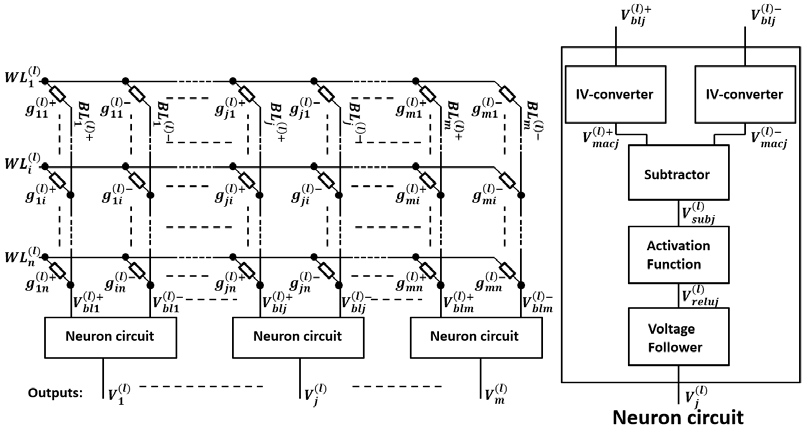
- We have proposed an algorithm (software) method to address the offset voltage issue of operational amplifier in DNN inference accelerators in advanced process. This method is verified in a larger dataset.
- Fully Analog ReRAM Inference Accelerator: An open-source framework for exploring fully analog ReRAM inference accelerators that avoid repeated inter-layer ADC/DAC conversions. It models ReRAM synapse arrays and analog neuron circuits for current-to-voltage conversion, subtraction, activation, and inter-layer driving. Finite-gain and offset models, together with hardware-conscious training tools, support studies of how circuit nonidealities affect inference accuracy.
Shuchao Gao, Takashi Ohsawa
Presented at SSDM 2023.
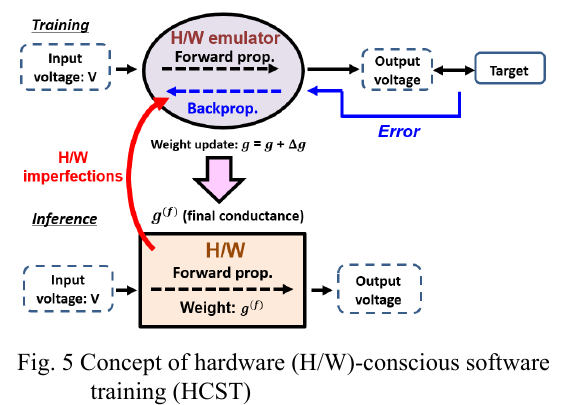
- We have proposed an algorithm (software) method to address the offset voltage issue of operational amplifier in DNN inference accelerators in advanced process. This method is verified in IRIS dataset.
Hardware-conscious Training for Deep Neural Network Inference Accelerators to Restore Accuracy Degradation due to Hardware Imperfection
ISIPS 2023
Shuchao Gao, Takashi Ohsawa
- We have designed a hardware training algorithm that can significantly improve the accuracy of DNN inference accelerators, even under the effect of the hardware imperfection introduced during the fabrication process. We compared offline training, in-situ training and on-chip training, and proved that hardware-conscious training is the best choice, which makes the non-volatile memory devices free from the endurance constraint, the nonlinearity and the asymmetry issues in updating the resistances.
Single Crossbar Array Architecture for High Density and Low Power Artificial Neural Network
ISIPS 2019
Shuchao Gao, Takashi Ohsawa
- We compared three different crossbar array structures to realize negative weight and introduced their training method. We used the Iris dataset to test and train the CBA. We also mathematically derive a single CBA training algorithm. It’s proved that single CBA can be more easily implemented in ReRAM CBA with lower error rate and more stability.
Training ReRAM Crossbar Array in Deep Neural Network
IEICE 2019
Shuchao Gao, Takashi Ohsawa
- We proposed a DNN training method to train ReRAM Crossbar Array (CBA). We designed and evaluated the Double Crossbar Array and Single Crossbar Array used to achieve negative weights, which also can perform complex matric multiplication at once only by the basic Ohm’s law and Kirchhoff’s Law.
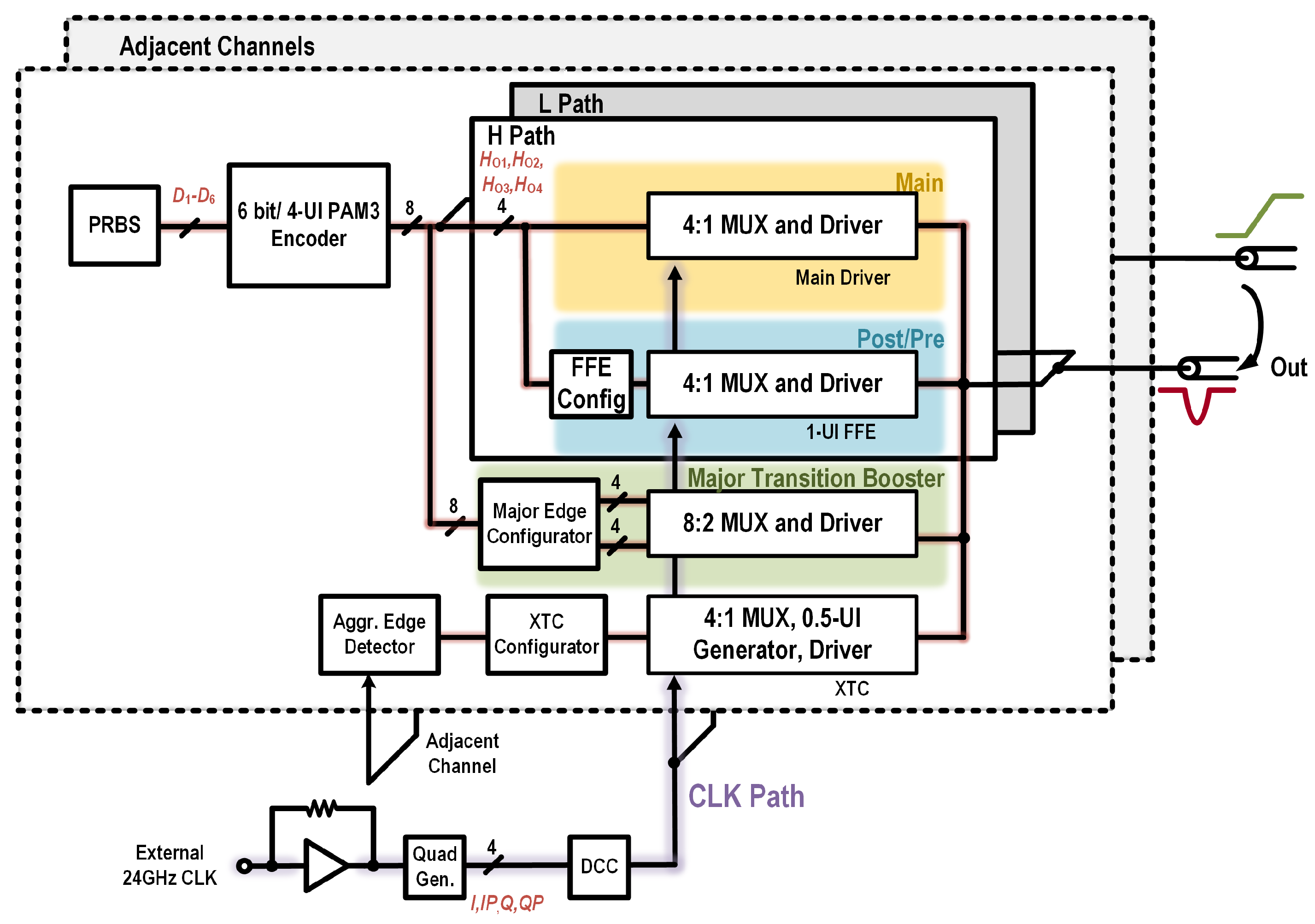
Wenxuan Zhang, Yiming Liu, Shuchao Gao
Microelectronics Journal, 176, 107361 (October 2026)
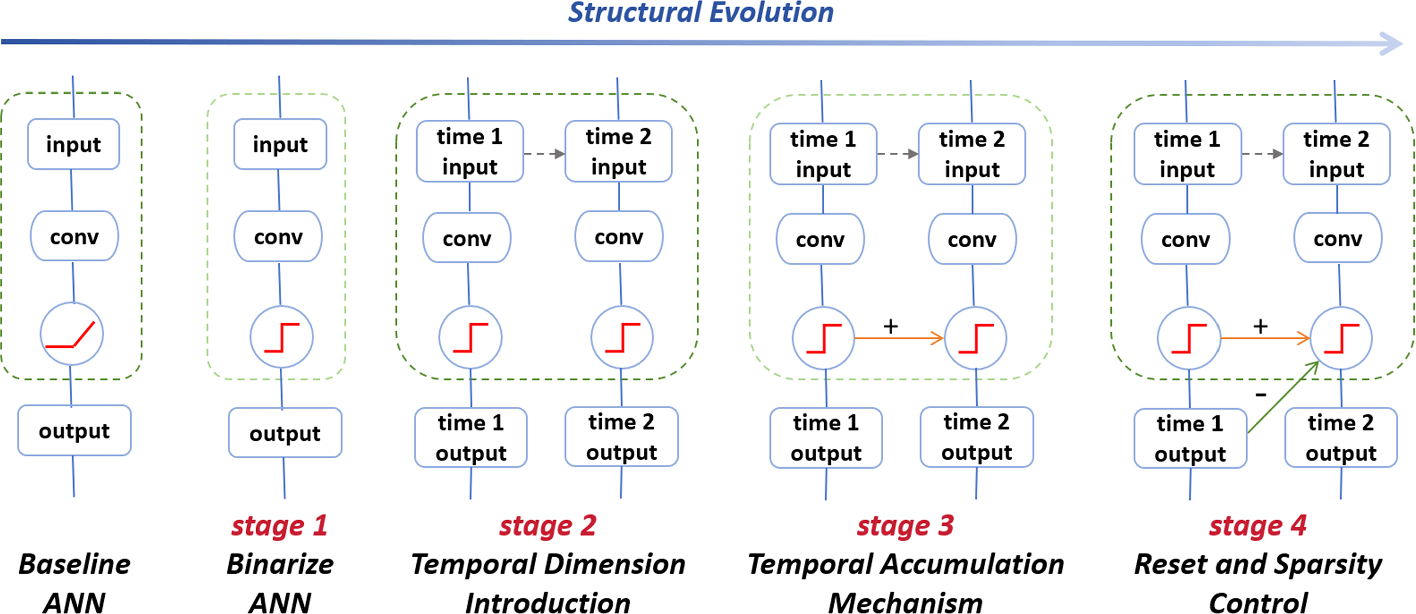
Huaxu He, Shuchao Gao
Neural Processing Letters, 58, 14 (2026)
- A four-stage framework connects binary ANNs to event-driven SNNs through temporal expansion, accumulation, reset, and sparsity control.
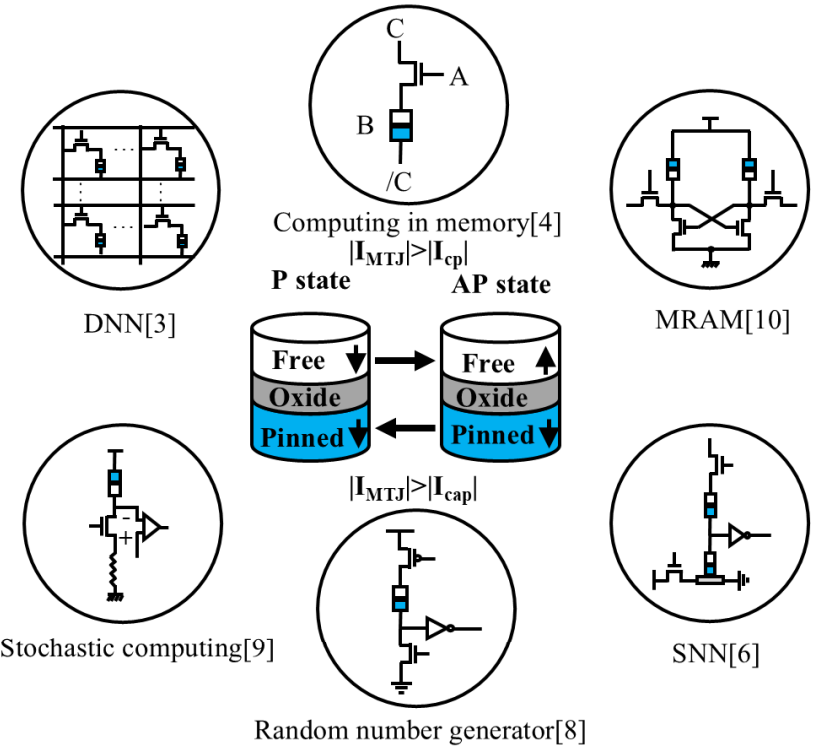
A High-Accuracy STT-MTJ SPICE Model Based on Variable Parameters
Haoyan Liu, Shuchao Gao, Chunshuang Chu, Kangkai Tian, Fuping Huang, Yonghui Zhang, and Zi-Hui Zhang
IEEE Transactions on Electron Devices, 72(7), 3543–3549 (2025)
- A variable-parameter SPICE model for accurate STT-MTJ device simulation.
🎖 Honors and Awards
- 2018.10 – 2019.03 MEXT Monbukagakusho Honors Scholarship (Japan)
- 2020.09 – 2021.03 MEXT Monbukagakusho Honors Scholarship (Japan)
- 2021.01 Young Researcher Scholarship (Waseda University)
- 2021.09 – 2023.09 China Scholarship Council (CSC) Ph.D. Scholarship
📖 Educations
- M.Eng., Emerging Memory Systems Laboratory, Waseda University
- B.Eng., University of Electronic Science and Technology of China
💻 Internships
- DATATOM, Distributed Cloud Storage System Development